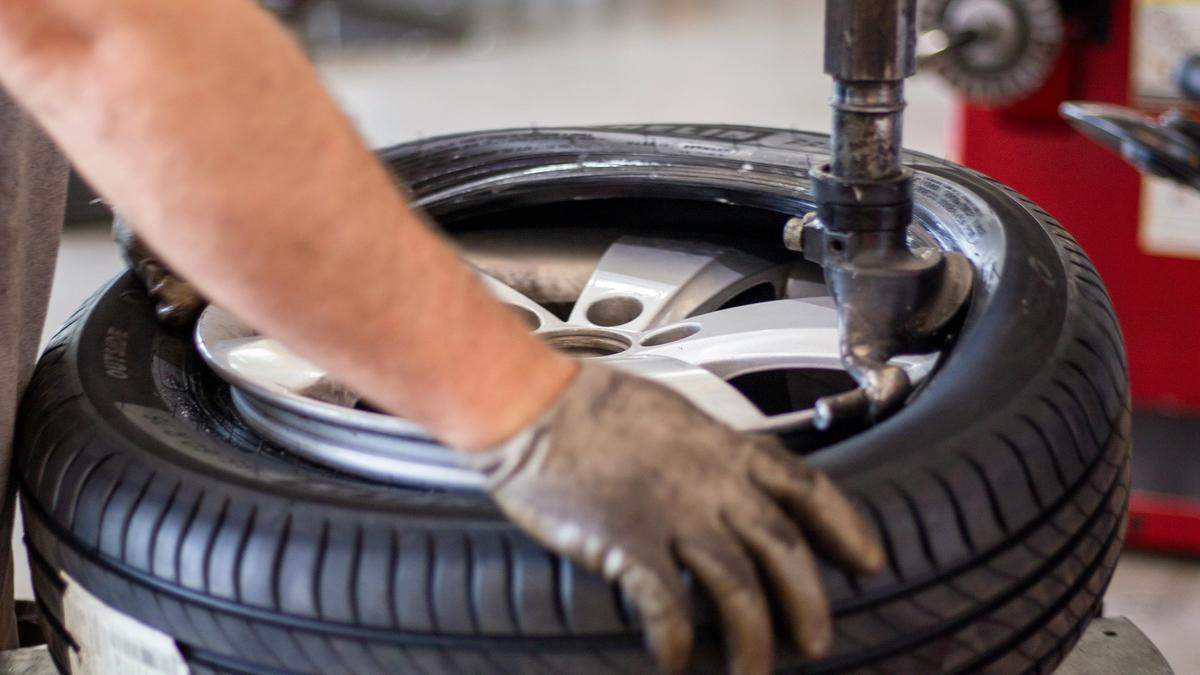
A tyre change done properly isn't just taking four wheels off and putting four wheels on. Tread condition, balancing, correct pressure and torqued bolts decide how long the tyres last, how settled the car feels and whether the steering wheel shakes on the motorway. It is really a small safety check dressed up as a routine job.
1. Tyre condition, first of all
Before fitting, the tread depth, uneven wear, cracking, cuts or bulges on the sidewall are checked — and, where relevant, the age of the tyre (the production date is stamped on the sidewall as four digits: week and year).
In Switzerland the legal minimum is 1.6 mm, but that is a legal limit, not a safety threshold. In the wet and on snow, the ability to clear water and find grip drops off well before that: which is why many garages suggest planning replacement at around 4 mm on winter tyres and 3 mm on summer tyres.
2. Fitting without damaging the wheel
Alloy wheels scratch easily: the wrong tools or a bit of haste leave marks on the rim edge, and on a painted alloy a deep scratch can eventually start corrosion. Care matters most with large diameters, low-profile tyres and expensive alloys, where the short sidewall leaves very little room to work.
3. Balancing: what it is and when it's really needed
No wheel is perfectly balanced: tyre and rim always have small weight differences around the circumference. The balancing machine finds the heavier spots, which are offset with small counterweights. The wheel then spins smoothly, even at speed.
If balancing is off, you get vibration through the steering wheel or cabin at certain speeds, uneven tread wear and less comfort. It matters particularly:
- when the tyre has been taken off the rim or is new;
- when you can already feel a vibration;
- when a balancing weight has come off;
- after a hard knock against a kerb or pothole.
If, on the other hand, you are fitting complete wheel sets that are already balanced and there is no vibration, balancing does not have to be redone at every seasonal change.
4. The right pressure comes from the car, not the tyre
Pressure decides how much of the tyre actually rests on the road. Too low: the shoulders work harder than the centre, the tyre heats up, the car feels less precise and fuel use (or range, on an EV) gets worse. Too high: mainly the centre carries the load, comfort drops and wear concentrates in the middle.
The correct value comes from the car manufacturer, not the tyre. You'll find it on the driver's door pillar, often on the fuel flap, in the owner's manual or in the on-board system. Two values are usually given: normal load and full load.
5. Tightening to torque
Torque is simply how tightly the wheel bolts are done up, measured with a torque wrench to the value the manufacturer specifies. Too little is dangerous, because a bolt can work loose; too much can distort the wheel or overstretch the bolt and make removal difficult next time — for example, at the roadside with a puncture.
Three details you pick up in the workshop
- Much heavier wear on one shoulder is a message. Simply fitting the next set makes the symptom disappear for a few months, but the cause — often alignment out of spec or a worn suspension component — goes on eating the new tyres too.
- The number printed on the sidewall is not the recommended pressure. It is the maximum pressure the tyre allows, not what your car needs. Using it as a guide almost always means overinflating.
- A vibration that shows up mainly above 90 km/h is almost a signature. In most cases it points to balancing rather than a fault with the tyres.
« Mechanic's tip: pressure changes with temperature, roughly 0.1 bar for every 10 °C. Tyres inflated correctly on a mild autumn afternoon will read lower on the first cold mornings. Check the pressure again a few weeks after the seasonal change, with the tyres cold. »
The practical step
When you book a tyre change, ask for the tread, the pressure to the manufacturer's figures and the bolt torque to be checked, and for any uneven wear to be flagged. Those few extra minutes tell you whether the tyres will see out the season and whether anything under the car deserves a closer look.