Brakes turn speed into heat every time you slow down, and that heat costs material. Pads and discs are wear parts: they get thinner no matter how gently you drive. What matters is noticing in time, and two checks you can do yourself are enough.
How a disc brake works, briefly
When you press the pedal, brake fluid pushes one or more pistons inside the caliper. The pistons squeeze two pads against the disc, which spins with the wheel. Friction slows the car and turns the energy of motion into heat, which the disc then has to shed into the air. Every stop takes a thin film of friction material off the pad and, to a smaller degree, cast iron off the disc. That is why brake pads and discs have a service life.
Useful ballpark figures: front pads last on average 30,000 to 60,000 km, discs roughly twice that, so they are often replaced with the second or third set of pads. City driving, mountain roads and heavy vehicles push those numbers down. Electric cars, which slow largely through regenerative braking, often push them up.
Signs that your brake pads are worn
- A high, constant squeal that stops the moment you brake. It isn't dirt. Many pads carry a metal tab set a few millimetres above the backing plate: once the material wears down to it, the tab touches the disc and squeals on purpose. It's a designed alarm, not a fault.
- A metallic grinding noise while braking. The friction material is gone and the pad's steel backing plate is working straight on cast iron. Every stop cuts deep grooves: at this point new pads alone won't do, you need discs as well. Get to a garage immediately.
- A pulsing pedal or shaking steering wheel under braking. Typical of a disc with uneven thickness: the pad meets alternately more and less material on each wheel rotation. It's called disc thickness variation (DTV), usually caused by overheating or by a disc that wasn't mounted cleanly on the hub.
- A pedal that sinks or feels soft. That isn't pad wear. The suspects are air or moisture in the circuit, or a fluid leak. Brake fluid is hygroscopic, it absorbs water over time and should be replaced roughly every two years.
- The car pulling to one side under braking. Usually a caliper that no longer slides on its guide pins, or a seized piston: one side brakes harder than the other.
- Yellow brake wear light: pads at their limit, book a check. Red light: stop driving.
Visual check of the pads: 30 seconds is enough
With the car parked and the brakes cold, look through the spokes of the wheel. You'll see the disc and, over its outer section, the caliper. Inside the caliper sit the two pads, one per side. What you're judging isn't the full thickness of the pad, only the friction material: the dark, matte layer bonded to the steel plate. The plate alone is 4 to 5 mm thick and doesn't wear.
Rule of thumb: below 3 mm of friction material, plan the replacement; below 2 mm, it's urgent. A new pad usually carries 10 to 12 mm, so there's plenty of margin if you check regularly. On drum brakes, common at the rear of smaller cars, the shoe limit is around 1 mm, but you have to take them apart to see it.
Check all four wheels and compare the two sides of the same axle. Front pads handle roughly 70% of the braking work, because weight shifts forward as you decelerate, and they wear out far sooner. If instead one pad on an axle is much more worn than its opposite, the problem isn't wear, it's the caliper.
The lip on the brake disc and what it means
« Before you touch anything, make sure the brakes are completely cold. After a hard stop a disc can exceed 300 °C and stays scorching for several minutes even with the car parked. Check at least half an hour after switching off, ideally in the morning before you set off. »
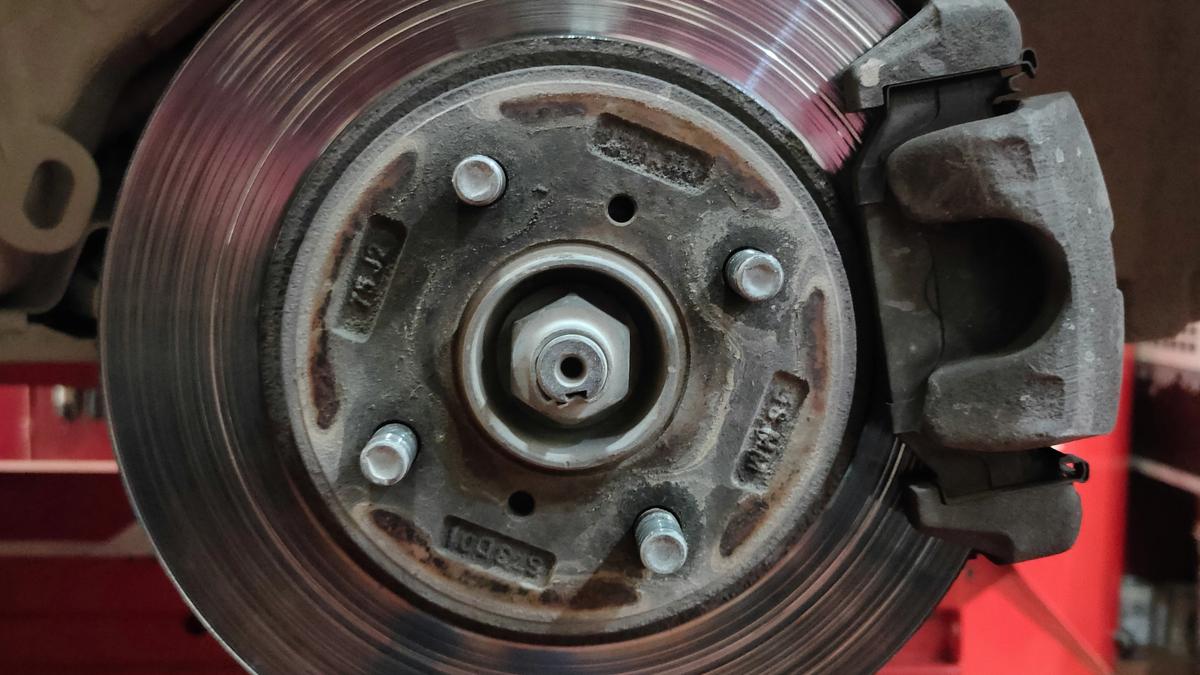
Then run a fingernail along the outer edge of the disc, where the shiny surface ends. You'll almost always feel a small step, what mechanics call the lip or wear ridge.
It forms because the pad is slightly narrower than the braking surface and never polishes that outermost millimetre. The rim stays at factory thickness while the track under the pads gets thinner. The lip therefore measures the material the disc has already lost.
Read it carefully, because it shows on one face while the disc wears on both. A 1 mm lip per side means roughly 2 mm of thickness gone, and on a front disc that measures 22 mm new with a 20 mm minimum, that already puts you at the limit.
A disc that's too thin creates three concrete problems.
- It sheds less heat. The cast iron mass is the system's thermal reservoir: less material means higher temperatures for the same braking effort. Downhill or during repeated stops, friction drops and stopping distances grow, an effect known as fading. Bluish patches on the braking surface are the visible trace of overheating.
- It's mechanically weaker. It warps more readily under thermal shock and, in the worst cases, can crack outward from the ventilation channels.
- It ruins new pads. On a heavily lipped disc a new, sharp-edged pad catches the ridge instead of lying flat on the track. Contact stays partial for thousands of kilometres, bringing noise, vibration and weaker braking.
The lip is still a clue, not a measurement. The objective figure is the minimum thickness stamped on the edge or the hat of the disc, marked MIN TH followed by the millimetres. The garage checks it with a micrometer at three or four points across the braking surface, because a caliper gauge resting on the rim would measure the lip rather than the worn area. At or below MIN TH, the disc has to be replaced, always per axle and on both sides, even if only one is out of spec: discs of different thickness don't brake the same way.
Two signals almost nobody links to the brakes
- One wheel far blacker with dust than the others, or very hot after a calm drive, sometimes with a metallic smell. The suspect is a caliper that isn't releasing, because of dirty guide pins or a seized piston. The pad drags constantly and disappears within a few thousand kilometres, while fuel consumption climbs.
- A film of rust on the disc after a rainy night. Completely normal, cast iron oxidises within hours and the first few stops clean it off. It's a different matter if rust stays on the braking surface after weeks of standing, or if it goes deep, in which case the disc needs assessing.
When to book a brake check
Book if you've heard metallic grinding, if pads are under 3 mm, if the lip is pronounced or if the pedal pulses. Acting early pays: replacing pads alone costs a fraction of a job that also needs discs. In Switzerland the braking system is also one of the items checked at the roadworthiness test (MFK), and arriving with brakes at their limit risks a defect.